Blog
Acacia Honey in Urdu: What Palosa and Phulai Really Mean

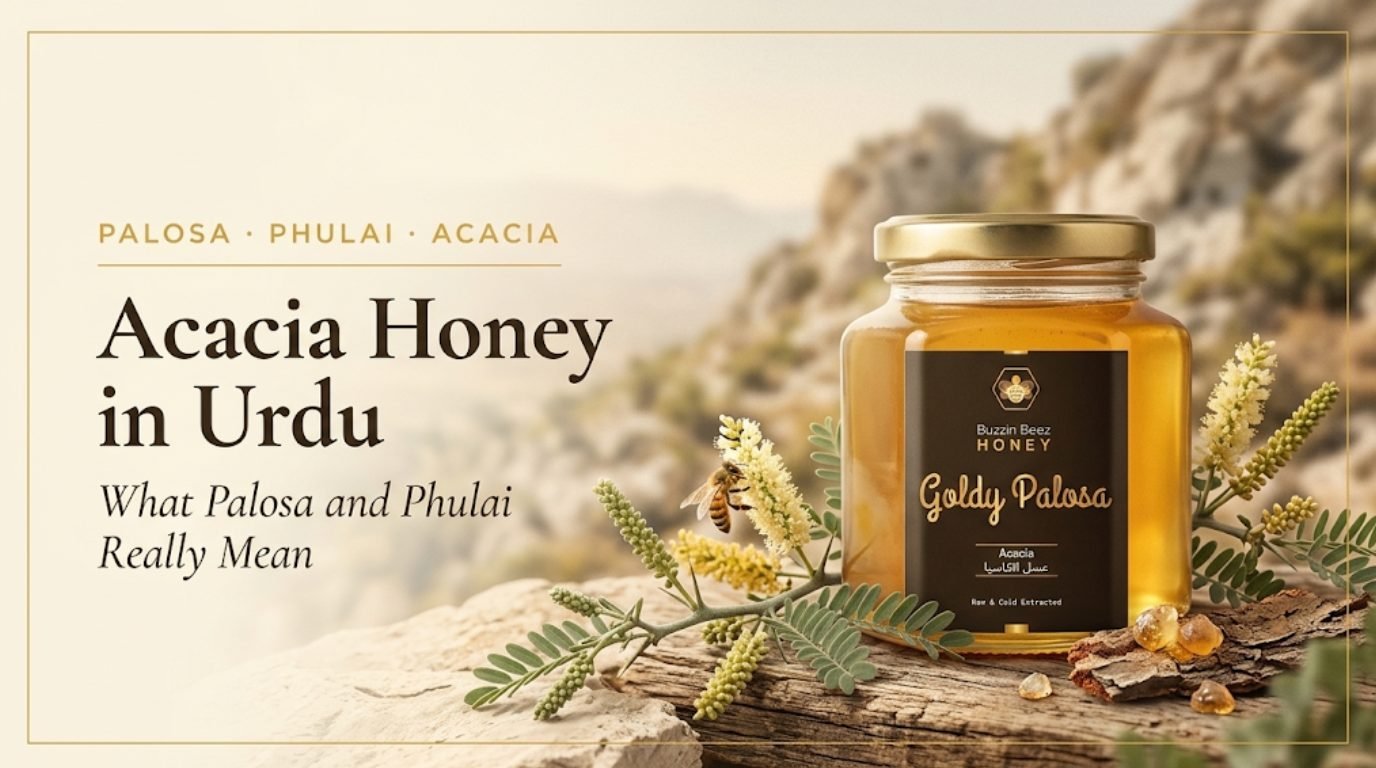
Ask for acacia honey in Urdu, and the answer you will hear across Pakistan is پلوسہ کا شہد, Palosa ka shehad. Ask what Palosa means in English, and people say acacia honey. Both answers are correct, and yet acacia honey in Urdu carries a story considerably stranger than a simple translation.
The honey sold across Europe and much of the world as “acacia” does not come from an acacia tree at all. Pakistani Palosa honey, on the other hand, comes from a tree that genuinely belonged to the Acacia genus until botanists reorganised it two decades ago.
This guide covers the naming properly: what Palosa means in Urdu, Pashto, Punjabi, and English, which tree actually produces it, where that tree grows in Pakistan, and why the label on an imported jar of acacia honey means something quite different from the label on a Pakistani one.
What Is Acacia Honey in Urdu?
The short answer first, since that is what most people came for.
Acacia honey in Urdu is پلوسہ کا شہد (Palosa ka shehad). You will also see it written as پھلائی کا شہد (Phulai ka shehad), depending on the region.
Both names point to the same tree. Palosa comes from Pashto, where پلوسہ is the everyday word for the tree. Phulai is the more common Urdu and Punjabi form, written پھلائی, and in Punjabi you will also hear phalāhī, پھلاہی.
So when a Pakistani beekeeper says Palosa and a Punjabi farmer says Phulai, they are describing one tree. Goldy Palosa takes its name from the Pashto version, which is why the jar carries پلوسہ کا شہد rather than the Punjabi form.
For anyone searching the reverse direction, Palosa honey in English is acacia honey, and the Palosa tree in English is most often called the phulai tree or, botanically, Acacia modesta.
Palosa, Phulai, Phalahi: One Tree, Many Languages
Pakistan’s linguistic range creates genuine confusion here, so it helps to lay the names side by side.
| Language | Name for the tree | Script |
| Pashto | Palosa | پلوسہ |
| Urdu | Phulai | پھلائی |
| Punjabi | Phalahi | پھلاہی |
| English | Phulai tree, acacia | , |
| Botanical | Acacia modesta, now Senegalia modesta | , |
Regional preference explains which version of acacia honey in Urdu you encounter. Beekeepers in Khyber Pakhtunkhwa and the tribal districts tend toward Palosa. Punjab and the Salt Range areas lean toward Phulai. Retailers and export labels default to acacia, because that is what the international market recognises.
None of these names is wrong. Consequently, if you find one seller offering Palosa honey and another offering Phulai honey at different prices, compare the honey rather than assuming they are separate varieties.
The Acacia Naming Problem: Most “Acacia Honey” Is Not Acacia
Here is where acacia honey in Urdu gets genuinely interesting, and where anyone buying imported honey deserves to know what they are actually holding.
The honey sold globally as acacia honey comes overwhelmingly from Robinia pseudoacacia, a tree native to a small part of the eastern United States and known in America as black locust. Jean Robin, royal botanist to King Henry IV of France, brought it to Europe in the early 1600s. It spread widely across Eastern Europe, which became the centre of world acacia honey production.
Look closely at the species name. Pseudoacacia translates as false acacia, a label botanists applied precisely because the tree resembles an acacia without being one. Robinia sits in a different subfamily of the legume family entirely, and it has never belonged to the Acacia genus.
Despite that, the European Union permits “acacia honey” as a trade label for Robinia honey under Council Directive 2001/110/EC. The naming is therefore legal and long-established rather than deceptive. Nevertheless, it means an imported jar labelled acacia honey almost certainly contains black locust honey from a North American tree.
Now compare Palosa. Acacia modesta carried the Acacia name for well over a century. Around 2005 to 2011, botanists split the sprawling Acacia genus, reserving the name mainly for Australian species and moving African and Asian species into Senegalia and Vachellia. Palosa accordingly became Senegalia modesta.
Being precise matters here, so we will not overclaim. Under current taxonomy, neither Robinia nor Palosa sits in the genus Acacia. However, the two are not remotely equivalent. Palosa was a true acacia and remains in the same subfamily alongside its former genus-mates. Robinia never was one, and belongs to a different branch of the legume family altogether.
Acacia modesta: The Tree Behind Goldy Palosa
Acacia modesta, now Senegalia modesta, is a modest tree in the literal sense.
It grows to roughly three to five metres in typical conditions, occasionally reaching seven metres over a long rotation. Its bark runs rough and greenish-grey to brown, its young shoots carry thorns, and its leaves divide into three to five pairs of small leaflets. When it blooms, it produces fragrant pale-yellow to cream flowers arranged in slim spikes.
Hardiness defines it. The tree tolerates annual rainfall anywhere between 250 and 1,300 millimetres, handles temperatures from minus five to forty degrees Celsius, and shows genuine frost resistance. Drought barely troubles it. Those traits explain why it thrives across some of the driest inhabited parts of Pakistan where little else of value grows.
Growth is slow, though. In managed forests, the tree runs on a thirty-year felling cycle and a sixty-year rotation before reaching seven metres and twenty centimetres in diameter. A Palosa stand is not something a landowner establishes quickly.
That slowness feeds directly into honey supply, because nobody can plant mature flowering stands to order.
Where the Palosa Tree Grows in Pakistan
Palosa occupies a specific band of Pakistani terrain: the Himalayan foothills, the Salt Range, the Sulaiman Hills, Balochistan, and the Kirthar Range.
Look at that list, and a pattern behind acacia honey in Urdu emerges. Every one is a dry, rocky, hilly country rather than an irrigated plain. Palosa colonises ground that heavily sprayed commercial agriculture largely ignores, which matters considerably for honey quality. Hives placed among hill Palosa face far less pesticide pressure than hives working farmland margins.
Sourcing from these areas also produces honey that differs noticeably from imported acacia. Where European Robinia honey runs almost water-clear with vanilla notes, Palosa honey from Pakistani hill country carries a golden hue and a mildly woody character. Different tree, different nectar, different honey.
Our guide on spotting real honey in Pakistan covers how to check those sensory markers.
Palosa Flowers and Why the Honey Is Seasonal
Palosa produces its cream-coloured flower spikes in two windows: April to May, and again in July to August depending on location and rainfall.
Bloom duration stays short in both windows. Beekeepers therefore have to position hives close to a concentrated flowering stand and move quickly, because the nectar flow lasts weeks rather than months. Miss the timing and the result is a mixed hill honey carrying a faint Palosa note instead of a genuine single-source honey.
Rainfall complicates matters further. A dry spring weakens the bloom, while rain during flowering keeps bees inside and strips nectar from the flowers. Yield consequently swings year to year in ways that irrigated crops do not.
Anyone comparing honey varieties will find this useful context. Palosa remains more affordable than Sidr because it flowers more reliably across more accessible terrain, a contrast our guide to beri ka shehad sets out in detail. Even so, Palosa is nothing like an industrial monocrop.
Palosa Tree Gum: The Other Product
Anyone searching for Palosa tree gum has the right idea. The tree genuinely produces one.
Acacia modesta exudes a gum in the form of pale yellow tears of mucilage, and that exudate has real commercial value as a source of gum arabic. Across South Asia, the gum has served in traditional medicine, food preparation, and adhesives for generations.
Honey and gum come from the same tree yet through entirely separate routes. Gum forms as a sap exudate from bark, whereas honey originates as flower nectar processed by bees. Neither product contains the other. Buy Palosa honey expecting gum properties, or gum expecting honey, and disappointment follows on both counts.
What This Means When You Buy Acacia Honey in Pakistan
Pull the threads together, and a practical rule for buying acacia honey in Urdu terms emerges.
Check which tree, not just which word. A jar labelled acacia honey might contain Robinia honey from Eastern Europe or Palosa honey from the Salt Range. Both are legitimate honeys, and neither is fraudulent, though they are genuinely different products.
Expect different sensory markers. Imported Robinia acacia honey runs very pale, almost transparent, with vanilla notes. Pakistani Palosa runs golden with a mild woody character.
Treat Palosa and Phulai as the same purchase. Regional naming does not indicate a different variety.
Weigh the freshness trade-off. Imported honey travels for weeks or months. Locally harvested Palosa reaches a Pakistani buyer far sooner and generally costs less per kilo.
For a fuller comparison across every variety we produce, see our guide to the different types of honey in Pakistan, which also covers how acacia compares against Sidr and against ordinary blended honey. If you want the label terminology explained, our guide to raw, pure and organic honey unpacks what each of those words legally means in Pakistan.
Where to Read More
We have kept this page on acacia honey in Urdu, its botany, and its origin. Other pages cover the rest:
- Taste and uses of Palosa honey: Top BuzzinBeez honey varieties
- Current pricing and pack sizes: Goldy Palosa product page
- How Palosa compares with other varieties in Karachi households: Customer favourites
- The full range: Browse all BuzzinBeez honey
Frequently Asked Questions
What is acacia honey called in Urdu?
Acacia honey in Urdu is پلوسہ کا شہد (Palosa ka shehad), or پھلائی کا شہد (Phulai ka shehad) in areas where Phulai is the preferred name. Both refer to honey from the same tree.
What is Palosa honey in English?
Palosa honey in English is acacia honey. English speakers call the tree itself the phulai tree, and its botanical name is Acacia modesta, which botanists reclassified as Senegalia modesta.
Is Pakistani Palosa honey the same as imported acacia honey?
No. Imported acacia honey almost always comes from Robinia pseudoacacia, the black locust or false acacia, a North American tree. Palosa honey comes from Acacia modesta, native to Pakistan. Both carry the acacia label legitimately, yet they are different honeys with different colour and flavour.
Where does the Palosa tree grow in Pakistan?
Across the Himalayan foothills, the Salt Range, the Sulaiman Hills, Balochistan and the Kirthar Range. It favours dry, rocky, hilly ground and tolerates drought and frost well.
Does the Palosa tree produce gum?
Yes. Acacia modesta exudes a pale yellow gum used commercially as a source of gum arabic and traditionally in medicine and food preparation. The gum and the honey come from the same tree through completely separate processes.
When does Palosa flower?
Palosa blooms in April to May and again in July to August, depending on location and rainfall. Each flowering window lasts only a few weeks, which limits how much single-source honey any season produces.
