
Blog
Lavender in Pakistan: The Balochistan Highlands Behind Relaxic Lavender

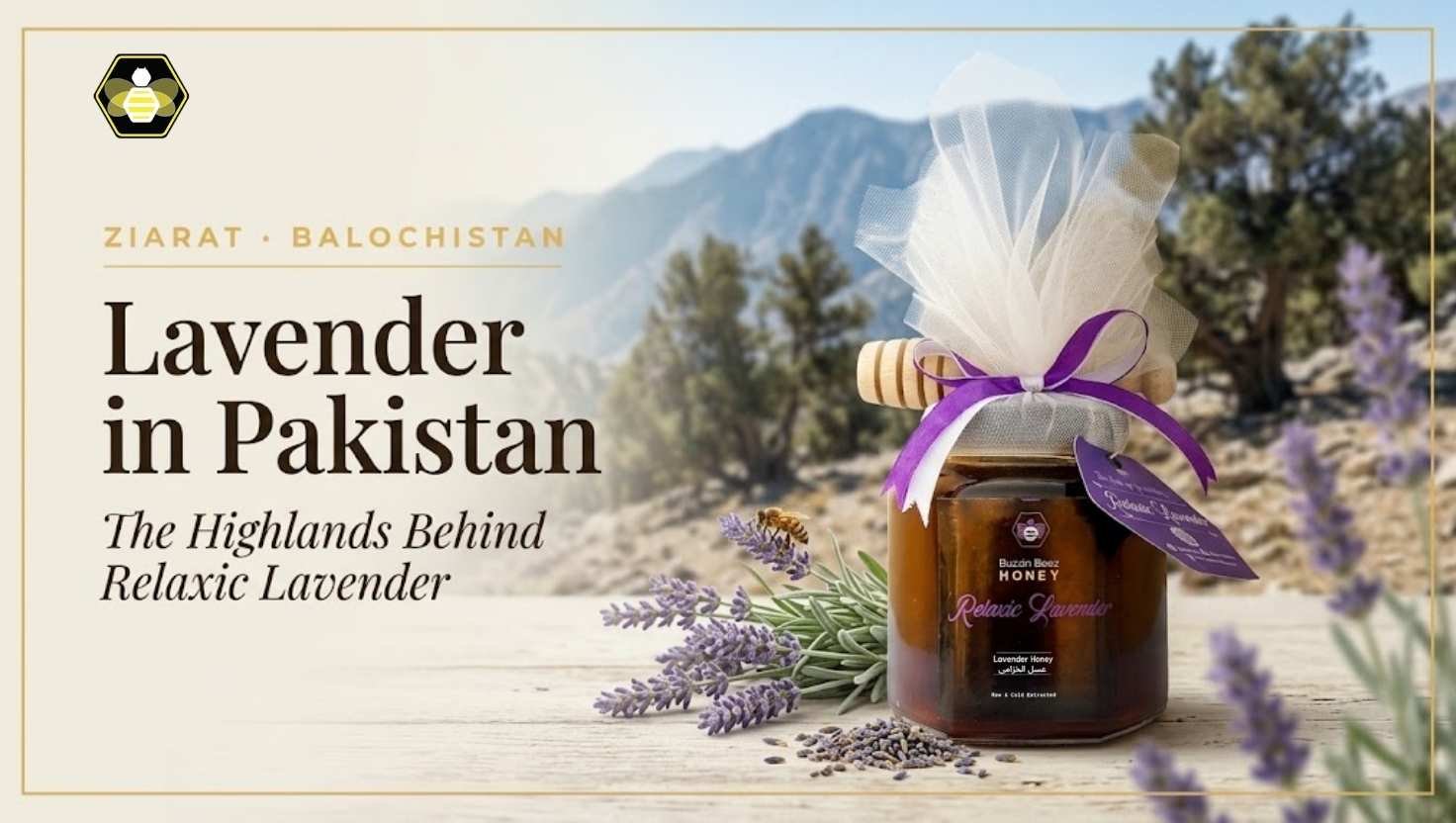
Mention lavender, and most people picture the purple rows of Provence in southern France. Very few pictures of Balochistan. Yet lavender in Pakistan is not a novelty or an import, and the highlands above Quetta support it well enough that bees forage there and produce a honey almost nobody outside the region has tasted.
This guide treats lavender in Pakistan as a plant and a place rather than a list of wellness claims. You will find out whether lavender genuinely grows here, which districts support it, what species sits behind Relaxic Lavender, when it flowers, and why Pakistani lavender honey stays so much rarer than Acacia or Sidr.
If you came looking for the calming side, we have written about that separately and linked it near the end, so this page can stay on the geography.
Does Lavender Actually Grow in Pakistan?
Yes, and in two quite different ways.
Wild lavender populations exist in parts of Balochistan. Agricultural researchers in Pakistan have noted this directly, and gardeners familiar with the region describe substantial wild stands around Ziarat in particular. Nobody planted those. They have simply persisted in terrain that happens to suit them.
Separately, cultivated lavender in Pakistan has grown steadily as both a garden plant and a commercial interest. Nurseries across the country now sell seedlings, and agricultural bodies have flagged lavender oil as an underdeveloped opportunity for Pakistani growers. Researchers have pointed to Potohar, Chitral, Gilgit-Baltistan, and Azad Kashmir as further regions with suitable conditions, largely because rainfall there drains away rather than sitting around the roots.
Drainage shapes where lavender in Pakistan survives more than most people expect. Lavender evolved on dry Mediterranean hillsides, so it tolerates poor soil and drought comfortably while rotting quickly in humid, waterlogged ground. Consequently, Pakistan’s monsoon belt makes a poor home for it, whereas the arid uplands of Balochistan make an unusually good one.
That distinction explains why lavender in Pakistan concentrates where it does. Altitude, cool nights, sharp drainage, and low humidity matter far more than latitude.
Where Lavender Grows in Pakistan: Ziarat and Loralai
Two districts account for most of the discussion of lavender in Pakistan as a honey source. BuzzinBeez lists Ziarat and Loralai in Balochistan, together with Jalalabad in Afghanistan, as the nectar locations for Relaxic Lavender, and the geography behind that choice is worth understanding.
Ziarat sits roughly 130 kilometres from Quetta at an elevation of about 2,543 metres, close to 8,343 feet. Its climate is continental rather than subtropical, which means genuinely cold winters and summers that stay cool while the rest of Pakistan bakes. Very few inhabited places in the country offer that combination.
The district owes its fame to something else entirely. The Ziarat juniper forest covers around 110,000 hectares and ranks as the largest juniper forest in Pakistan. UNESCO designated it a Biosphere Reserve in 2013, and it entered the World Heritage tentative list in 2016. Some of those junipers reportedly date back thousands of years.
That forest matters for honey in an indirect but important way. Protected forest land faces far less pesticide pressure than commercial farmland, so hives placed in these valleys forage in comparatively clean air. Loralai, to the northeast, shares much of the same upland character.
Neither district produces lavender at anything approaching industrial scale. Instead, the plant grows in scattered wild stands and small cultivated patches across highland terrain. Beekeepers, therefore, have to place hives carefully and accept modest yields, which brings us to the scarcity question.
Lavandula angustifolia: The Species Behind the Honey
The species named on the Relaxic Lavender product page is Lavandula angustifolia, commonly called English lavender or true lavender.
Botanically, it is a small woody shrub rather than a herb, generally staying under a metre tall, with narrow grey-green leaves and the familiar purple flower spikes. It belongs to the Lamiaceae family, which also includes mint, basil, rosemary, and thyme. Anyone who has crushed a rosemary leaf will recognise the resinous, aromatic quality that runs through the whole family.
Lavandula angustifolia handles cold better than its relatives, tolerating conditions down through USDA hardiness zones 6 to 9. French lavender, Lavandula dentata, copes better with heat and suits the Pakistani plains, while English lavender performs far better in cooler hill locations. Ziarat’s altitude places it firmly in English lavender territory.
Nectar chemistry follows from all this. The essential oils that give lavender its scent, principally linalool and linalyl acetate, sit in the flowers alongside the nectar. Traces carry through into the finished honey, which is why genuine lavender honey smells faintly of the plant rather than simply of sweetness.
When Lavender Flowers in Pakistan
Timing separates genuine mono-floral honey from a wildflower honey carrying a hint of lavender, and the bloom calendar for lavender in Pakistan runs shorter than most people assume.
Pakistani agricultural researchers describe the plant flourishing through February and March as spring arrives, with harvest activity later in the year around September and October. Altitude shifts that calendar, though. At Ziarat’s elevation, spring arrives considerably later than it does in the plains, so the bloom runs behind the lowland schedule.
Flowering itself lasts a matter of weeks. During that window, hives have to sit close enough to a concentrated stand of lavender that bees forage predominantly on it. Place them too far away, and the bees will simply work whatever else is blooming, producing a mixed honey instead.
Weather adds further risk. Late frost damages the blooms, and rain during flowering keeps bees inside the hive and washes nectar from the flowers. A single badly timed week can shorten an already brief season substantially.
Why Pakistani Lavender Honey Stays Rare
Four constraints compound each other here.
Limited growing area. Lavender in Pakistan occupies a narrow slice of terrain, unlike Acacia, which flowers across broad stretches of Punjab and Sindh. Our Palosa tree guide explains why that abundance keeps Acacia honey affordable.
A short bloom. Weeks rather than months, once a year.
Difficult access. Ziarat lies at altitude on mountain roads. Moving hives in and harvested frames out costs considerably more than working a Punjab farm road.
Small yields per hive. Scattered wild stands cannot support the density of foraging that a cultivated monocrop provides.
Taken together, those factors put lavender honey in the same scarcity bracket as Sidr, though for entirely different reasons. Sidr is rare because wild Beri trees flower briefly in remote terrain, a story our beri ka shehad guide covers in detail. Lavender is rare because the plant barely grows here at all.
Pakistani Lavender Honey Compared With Provence
France produces the world’s best-known lavender honey, drawn largely from Lavandula angustifolia grown across the Provence plateaus. Comparing Provence with lavender in Pakistan is useful, and honesty requires acknowledging where France leads.
French lavender honey benefits from enormous cultivated acreage, generations of accumulated beekeeping expertise, and formal appellation protections that verify origin. Pakistan offers none of that infrastructure.
What Pakistani lavender honey does offer is freshness and proximity. Imported honey spends weeks or months in transit, and stability across that journey generally favours heat treatment. Honey extracted in Balochistan and jarred here reaches a Pakistani buyer far sooner. It also costs a fraction of what imported lavender honey commands after duty and freight.
Flavour differs too. Provence lavender honey is typically very pale with a pronounced floral perfume, reflecting dense monocrop foraging. Highland Pakistani lavender honey, gathered from scattered stands among juniper and other native vegetation, tends toward a slightly deeper colour and a more herbal, less purely floral character.
Neither is superior in any absolute sense. They are different expressions of the same species grown in very different places.
How to Recognise Genuine Lavender Honey
A few checks help before you buy.
Smell it first. Real lavender honey carries a light floral note under the sweetness. Absence of aroma suggests either heavy processing or a different nectar source entirely.
Read the label wording carefully. “Lavender honey” and “lavender-infused honey” describe different products. Infused versions are ordinary honey blended with lavender extract or oil after extraction, which is a legitimate product but not mono-floral honey and not priced the same way.
Look for a named species and district. A brand named Lavandula angustifolia and a specific district have committed to something checkable.
Expect a pale to light amber colour. Very dark honey sold as lavender warrants questions.
Ask for documentation. Sensory checks catch obvious substitutions, while only laboratory analysis confirms purity properly. Our guide to what honey lab tests check explains what a genuine report should show.
For a fuller walkthrough across every variety, see our guide to spotting real honey in Pakistan.
Where to Read More
We have kept this page on the plant and the place deliberately. Recipes and everyday uses have their own home:
- Recipes and everyday uses: How to use lavender honey every day
- How lavender compares with the other varieties: Guide to different types of honey in Pakistan
You can also browse the full honey range to compare Relaxic Lavender against Sidr, Acacia, and Ajwain.
Frequently Asked Questions
Does lavender grow in Pakistan?
Yes. Wild lavender in Pakistan occurs in parts of Balochistan, notably around Ziarat, and cultivated lavender grows in gardens and small farms nationwide. Researchers have also identified Potohar, Chitral, Gilgit-Baltistan, and Azad Kashmir as suitable regions.
Where does BuzzinBeez source its lavender honey?
The Relaxic Lavender product page names Ziarat and Loralai in Balochistan and Jalalabad in Afghanistan as the nectar locations, with Lavandula angustifolia as the nectar source.
What is lavender called in Urdu?
Urdu generally uses لیونڈر, transliterated as “lavender” or “lavendar”. No widely used indigenous Urdu name exists, largely because the plant never became a staple of local agriculture.
Which lavender variety grows best in Pakistan?
English lavender, Lavandula angustifolia, suits cooler highland areas such as Ziarat, Murree, and Abbottabad. French lavender, Lavandula dentata, tolerates heat better and performs more reliably in Lahore, Karachi, and Multan.
Why is lavender honey more expensive than Acacia honey?
Growing area, bloom length, access difficulty, and yield per hive all work against lavender in Pakistan. Acacia flowers abundantly across accessible farmland in Punjab and Sindh, whereas lavender grows in scattered highland stands with a short annual bloom.
Is Pakistani lavender honey as good as French lavender honey?
They differ rather than rank. France offers greater scale, longer expertise, and formal origin protection. Pakistani highland lavender honey offers freshness, a much lower cost, and a more herbal character shaped by the surrounding mixed vegetation.
