Blog
Palosa Honey: Taste, Uses & the Acacia Tree Explained

If you’ve ever searched for affordable, everyday honey in Pakistan, chances are the name “Palosa” appeared at the top of your list. But what exactly is Palosa honey, what is the palosa tree it comes from, and why does this particular variety behave so differently from the dark, thick Sidr honey most Pakistanis consider premium?
In this guide, we explore everything about the palosa tree (Acacia), the honey it produces, how it tastes, why it stays liquid longer than any other honey, and how it compares to Sidr honey in taste, price, and use. Whether you know it as Palosa, Acacia, or Babool honey, this is the only guide you need.
What Is the Palosa (Acacia) Tree?
The palosa tree belongs to the Acacia family, a large genus of trees and shrubs that grow abundantly across the plains and arid regions of Pakistan. In Urdu, it’s commonly called Palosa (پلوسہ), Babool, or Kikar, depending on the region and the specific species. Internationally, honey from this tree falls under the “Acacia honey” category.
Unlike the Sidr tree, which grows wild in remote mountain regions, the palosa tree thrives in the accessible lowlands of Southern Punjab, Sindh, and parts of Khyber Pakhtunkhwa. These trees flower more frequently and across wider stretches of land, which means beekeepers can harvest Palosa honey in larger quantities and across multiple seasons each year.
The palosa tree typically features feathery green leaves, clusters of small yellow or white flowers, and long, curved seed pods. Its flowers produce a light, sweet nectar that bees convert into one of the mildest, most elegant honeys available anywhere in the world.
Because the palosa tree grows in relatively warmer, drier climates, the resulting honey carries a distinctly clean, floral sweetness without the heavy, complex undertones found in honeys from mountainous regions. This lightness is precisely what makes Palosa honey so popular among families looking for a gentle, everyday honey.
Where Palosa Honey Comes From in Pakistan
Pakistan’s geography creates ideal conditions for Palosa honey production. The palosa tree grows widely across several key honey-producing regions:
Southern Punjab remains the heartland of Palosa honey in Pakistan. Districts like Multan, Bahawalpur, Dera Ghazi Khan, and Rahim Yar Khan have vast stretches of Acacia trees that flower each year reliably. Most commercial beekeepers in Punjab position their hives along these Acacia corridors during the flowering season.
Sindh contributes significantly to Palosa honey production, particularly from the Thar Desert region and the agricultural zones of upper Sindh. The hot, dry climate of Sindh produces a Palosa honey that’s slightly lighter in colour compared to its Punjabi counterpart.
Khyber Pakhtunkhwa also hosts Acacia trees in its lower-altitude areas, though production volumes here tend to be smaller than in Punjab and Sindh.
The key difference between Palosa and Sidr honey at the sourcing level is availability. While Sidr trees bloom only once or twice a year in remote, hard-to-reach areas, the palosa tree flowers more frequently and across easily accessible farmlands. This higher availability directly translates into a lower price point, making Palosa honey the most accessible premium honey in Pakistan.
Why Palosa Honey Stays Liquid: The Fructose Explanation
One of the most distinctive characteristics of Palosa honey is its tendency to remain liquid and runny for far longer than other honey types. Many buyers find this puzzling, since conventional wisdom says that “real honey crystallises.” So does liquid Palosa honey mean it’s fake?
Not at all. In fact, the science behind it is straightforward.
Honey crystallises when its glucose molecules form solid crystals over time. The speed of crystallisation depends on the ratio of glucose to fructose in the honey. Honeys with a higher glucose content (like Sidr or Clover) crystallise faster, while honeys with a higher fructose content resist crystallisation for much longer.
Palosa (Acacia) honey has one of the highest fructose-to-glucose ratios of any honey variety in the world. This naturally high fructose content keeps Goldy Palosa smooth, clear, and pourable for months, sometimes even a full year, without any crystallisation. Therefore, its liquid state is actually a sign of authenticity, not a red flag.
This property also makes Palosa honey ideal for drizzling over food, stirring into drinks, and cooking. It blends smoothly without clumping, unlike thicker varieties that require warming first.
Why People Love Palosa Honey
Beyond its pleasant taste and texture, Palosa honey has a few practical qualities that make it a favourite for everyday use:
Mild, Light and Easy to Use Every Day
Palosa honey’s mild flavour makes it easy to use every day. For anyone who finds darker, stronger honeys too intense, Palosa is a comfortable alternative: it sweetens chai without overpowering it and pairs well with fruit, yoghurt and baking.
Best Mild Honey for Children and First-Timers
Not every family member enjoys the bold, intense flavour of Sidr or Ajwain honey. Children, especially, often prefer milder, sweeter tastes. Palosa honey’s light, floral sweetness makes it the ideal “starter honey” for kids above one year of age, picky eaters, and anyone new to the world of raw honey.
Its smooth, pourable texture also makes it easy to mix into milk, yoghurt, cereal, or warm water without any resistance. For families who like a mild sweetness in tea and milk, Palosa is the gentlest-tasting of our honeys.
Stays Runny for Longer
Because of its high fructose content, Palosa honey stays liquid much longer than most honeys, which makes it easy to drizzle and measure. When it eventually crystallises, standing the jar in warm water returns it to liquid.
For a complete comparison of how each honey variety serves different health needs, check our guide to different types of honey in Pakistan and their benefits.
Palosa vs Sidr Honey: Which Should You Buy?
This is one of the most common questions Pakistani honey buyers ask. The answer depends entirely on your purpose, budget, and taste preference. Here’s how they compare:
| Feature | Palosa (Acacia) Honey | Sidr (Beri) Honey |
| Tree Source | Palosa/Acacia/Kikar tree | Beri/Sidr/Ziziphus tree |
| Where It Grows | Plains of Punjab, Sindh, KPK | Remote mountains of Balochistan, KPK |
| Colour | Light golden, almost clear | Dark amber, rich golden |
| Taste | Mild, floral, gently sweet | Deep, caramel-like, complex |
| Texture | Thin, liquid, pourable | Thick, dense, slow-flowing |
| Crystallization | Very slow (stays liquid for months) | Moderate (may crystallise in weeks) |
| Best For | Daily use, children, cooking, mild sweetener | Special occasions, gifting, rich flavour |
| Price (500 g jar) | ₨ 1,096 | ₨ 2,250 |
Neither honey is “better” in absolute terms. Instead, they serve different purposes within a household. Many Pakistani families follow a smart strategy: they keep Goldy Palosa as a 500 g jar for daily use (chai, cooking, general sweetening) while keeping a smaller jar of Bairy Nectar (Sidr) for its rich, intense flavour and for gifting.
For a detailed deep dive into Sidr honey specifically, our guide to beri ka shehad covers its benefits, purity tests, and pricing.
Palosa Honey in Urdu: Names and Identification
For those searching for “acacia honey in Urdu” or trying to identify this variety at a local shop, here are the names you should recognise:
پلوسہ کا شہد (Palosa ka Shehad): This is the most commonly used Urdu name for Acacia honey in Pakistan. If a local beekeeper or shop mentions “Palosa,” they’re referring to honey from the Acacia tree.
ببول کا شہد (Babool ka Shehad): In some regions, particularly in Sindh and lower Punjab, the Acacia tree goes by the name Babool or Kikar. The honey may carry this name instead of Palosa, but the source tree and product are essentially the same.
Acacia Honey: The international English term used on most export-grade labels and online stores.
When shopping for Palosa honey, look for a light golden colour, a thin and pourable consistency, and a mild floral aroma. If the jar contains dark, thick honey labelled as “Palosa,” it’s likely mislabelled or blended with a different variety.
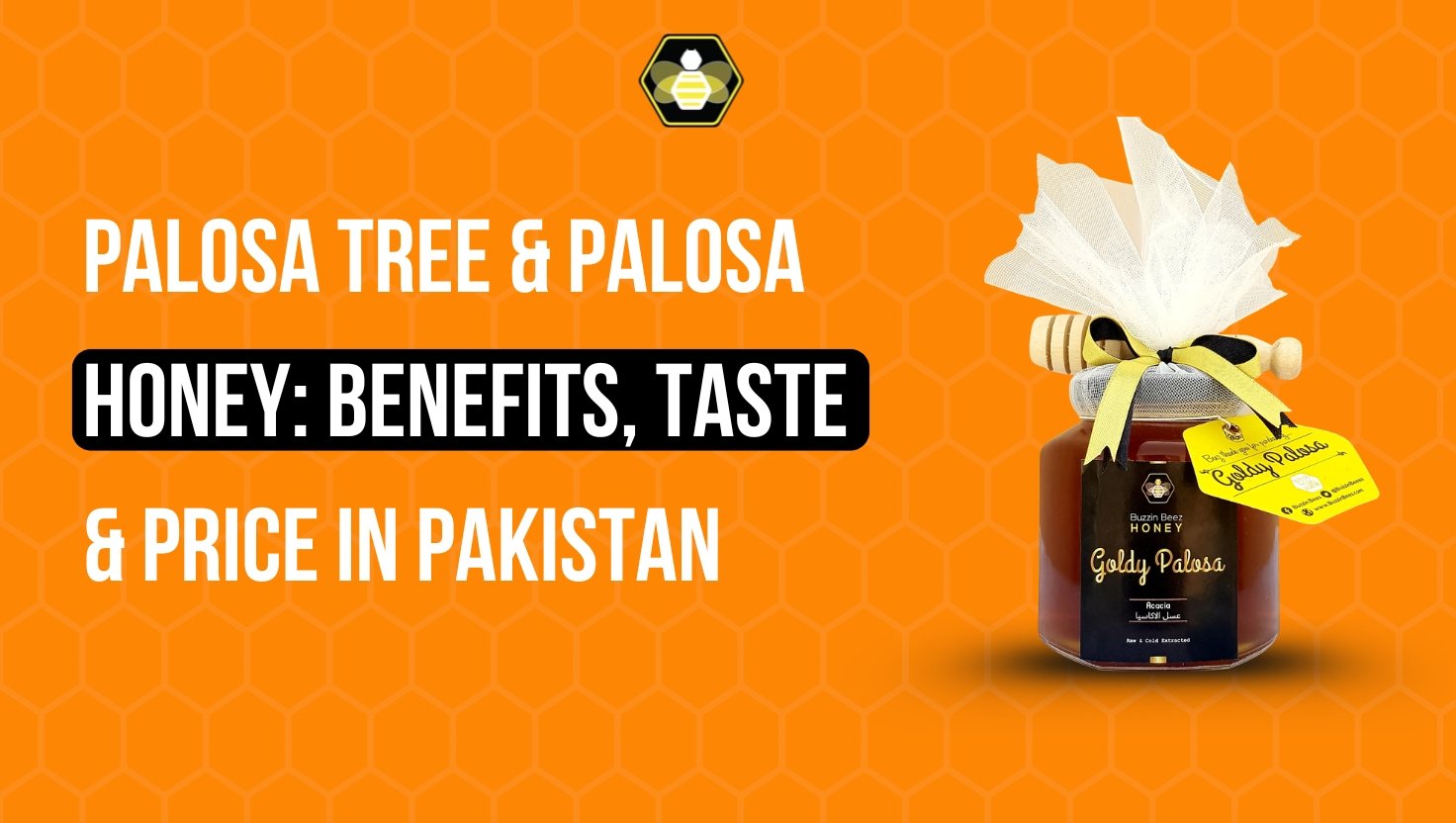
BuzzinBeez’s Goldy Palosa is authentic Acacia honey sourced from palosa trees in Buner, Khyber Pakhtunkhwa, and cold-extracted.
Palosa Honey Price in Pakistan (2026)
Because the palosa tree produces honey in larger quantities compared to the rare Sidr tree, Palosa honey sits at the most accessible price point among premium single-origin varieties in Pakistan. Here are the current BuzzinBeez prices:
| Size | BuzzinBeez Goldy Palosa Price | Per-Kg Rate |
| 150g | ₨ 495 | ₨ 3,300/kg |
| 250g | ₨ 645 | ₨ 2,580/kg |
| 500g | ₨ 1,096 | ~₨ 2,192/kg |
The 500 g jar works out cheapest per kilo (about ₨ 2,192 per kg, against ₨ 2,580 for the 250 g jar and ₨ 3,300 for the 150 g jar). For families that use honey daily, it is the practical size.
Compared to the wider market, single-origin Acacia honey in Pakistan typically ranges from ₨ 1,400 to ₨ 3,500 per kg. Goldy Palosa falls within that range while offering cold extraction and transparent sourcing.
You can explore BuzzinBeez’s full honey collection to compare Palosa pricing with other varieties like Sidr, Ajwain, and Lavender.
Frequently Asked Questions About Palosa Honey
Q: Is Palosa honey the same as Acacia honey?
Yes. Palosa is the Urdu name for the Acacia tree. Honey produced from its nectar goes by “Palosa honey” in Pakistan and “Acacia honey” internationally. The product is identical regardless of which name appears on the label.
Q: What is the difference between acacia honey and clover honey?
Both are light, mild honeys, but they come from different trees. Acacia honey comes from the palosa tree and has a higher fructose content, which keeps it liquid longer. Clover (Shaftal) honey crystallises faster and has a slightly different flavour profile, with a clean, mild sweetness.
Q: Can people with diabetes eat Palosa honey?
Honey, including Palosa, is a natural sugar. If you have diabetes, ask your doctor before adding any honey to your diet.
Q: Why does my Palosa honey look so thin and watery?
This is completely normal. The high fructose-to-glucose ratio in Palosa honey keeps it liquid and pourable for much longer than most other honeys. A thin, light-coloured consistency is actually a hallmark of genuine Acacia honey, not a sign of adulteration.
Q: Can I give Palosa honey to my children?
Absolutely, as long as your child is above one year of age. Honey of any type should never be given to infants under 12 months due to the risk of infant botulism. For children above one, Palosa honey’s mild flavour and gentle texture make it one of the best options available.
Q: Where can I buy genuine Palosa honey in Pakistan?
You can order Goldy Palosa directly from BuzzinBeez with cash on delivery across Pakistan.
