
Blog
What Is Shaftal? Persian Clover, Fodder and Honey Explained

Most people who type shaftal into Google are not looking for honey. They are farmers, students, or livestock owners looking for a winter fodder crop, and they land on honey pages that never explain the plant.
This guide fixes that. It covers what shaftal actually is, how it differs from berseem, where it grows in Pakistan, when it flowers, and the genuinely interesting relationship between the crop and the bees that pollinate it. The honey comes at the end, because the honey is a by-product of the farming rather than the other way round.
Clover honey benefits have their own page, linked near the bottom, so this one stays on the plant.
What Is Shaftal?
Shaftal is Persian clover, botanically Trifolium resupinatum, an annual legume grown across Pakistan as winter fodder. It reaches around 60 centimetres when cultivated and forms low rosettes when grazed or cut.
Like every clover, it belongs to the Fabaceae family, which makes it a nitrogen-fixing legume. Rather than draining the soil, it feeds it, pulling nitrogen from the air into root nodules and leaving the ground richer than it found it. Agronomists rate its soil-improvement potential above berseem for exactly this reason.
The name شفتل comes through Persian, which explains why the crop carries the same name across Iran, Afghanistan and northern Pakistan. English calls it Persian clover or reversed clover, the second name referring to the way its small flowers twist so the petals sit upside down compared with other clovers.
The crop is newer to Pakistan than most people assume. Agricultural records place its introduction around 1910 to 1915 in the Lahore region, arriving slightly before berseem, then spreading into the cooler, irrigated and higher-rainfall districts of the northwest.
Shaftal vs Berseem: Two Clovers, Constantly Confused
Pakistani farming uses two clovers and English lumps both under one word, which causes endless confusion.
| Shaftal | Berseem | |
| Botanical name | Trifolium resupinatum | Trifolium alexandrinum |
| English name | Persian clover | Egyptian clover |
| Climate suited to | Cooler, higher rainfall, northern areas | Milder winters, broad plains |
| Share of Pakistani farms | Limited | Grown by roughly 94 per cent of farmers |
| Forage yield | Lower | Higher |
| Soil improvement | Better | Good |
Berseem dominates because it simply produces more fodder per acre in a mild winter. Persian clover holds its ground where winters run colder, since it tolerates frost, stays dormant under snow cover, and regrows quickly once temperatures lift in early spring. It also handles waterlogged ground better than most legumes.
Honesty requires noting the drawbacks too. It delivers a lower forage return than berseem, and agricultural sources report that it can cause digestive upset in livestock if grazed carelessly. Those two facts explain why it never took over Pakistani fodder farming despite its agronomic advantages.
A Naming Dispute Worth Knowing About
Anyone reading closely across sources will hit a contradiction, so it is worth addressing directly.
Most references, including Wikipedia and Pakistani agricultural departments, treat the two names as one plant. Some botanical literature disagrees, arguing that the name properly refers to Trifolium clusii, the annual strawberry clover, and that applying the name to Persian clover is a long-standing misattribution.
In practice, when a Pakistani farmer, seed seller, or agriculture officer says shaftal, they mean Trifolium resupinatum. Local usage has settled the matter, whatever the taxonomic argument. We follow local usage throughout this guide, while flagging the dispute so anyone researching seriously knows it exists.
Naming tangles of this kind run right through honey. Our guide to acacia honey in Urdu covers a stranger one, where honey sold globally as acacia comes from a tree that is not an acacia at all.
Where Shaftal Grows in Pakistan
Persian clover favours cold. It thrives in the cooler, irrigated and heavier-rainfall districts of northern Pakistan, and internationally it grows at altitude, reaching 2,500 metres in the Afghan uplands and 2,750 metres in the Himalayas.
Frost resistance is its defining trait. The plant survives temperatures that finish berseem, goes dormant beneath snow, then regrows fast once early spring arrives. Consequently, it suits Khyber Pakhtunkhwa, the northern Punjab belt, and cooler irrigated pockets far better than the Sindh plains.
Sowing runs through autumn, growth continues across winter, and flowering follows in spring. Later-maturing varieties allow two spring hay cuts, which is where the timing gets interesting for beekeepers.
When Shaftal Flowers, and Why It Matters for Honey
Here is the tension at the centre of clover honey, and few people outside farming think about it.
Farmers grow the crop for leaf, not flower. Cutting for fodder happens before or during early flowering, because forage quality drops as the plant puts energy into seed. A field cut on schedule never reaches full bloom.
Bees need the opposite. They need the crop left standing long enough to flower properly, which happens either when a farmer grows the crop for seed rather than fodder, or on a later cut where the stand flowers before harvest.
That conflict makes clover honey genuinely seasonal and genuinely dependent on how nearby farmers manage their fields. A beekeeper cannot simply place hives beside any clover field and expect a crop. The field has to be flowering, and that means the farmer’s plan and the beekeeper’s plan have to line up.
Similar timing constraints shape every mono-floral honey we produce. Our guide to lavender in Pakistan covers a comparable narrow window in the Balochistan highlands.
Bees and Clover Need Each Other
This is the part worth knowing, and it changes how you see a jar of clover honey.
The relationship runs both ways. Clover feeds bees, and bees are what allow clover to set seed at all. Research conducted in central Punjab between 2012 and 2014 measured this directly on berseem clover, and the results were substantial: honeybees raised seed yields by 35 to 67 percent across every seed genotype tested. Combining an improved variety with honeybee access produced the best results recorded in the study.
Without pollinators, clover seed set fails. Failed seed set means less seed, less fodder, poorer livestock nutrition, and lower farm income. The chain runs directly from bees to milk.
The same research flagged something less comfortable. Honeybee populations in Pakistan are declining, driven mainly by widespread neonicotinoid pesticide use and habitat fragmentation. That decline threatens forage seed production as much as it threatens honey.
So a jar of shaftal honey represents a working relationship rather than simple extraction. The bees took nectar, and in return the crop set seed it could not have set alone.
From Shaftal Field to Shaftal Honey
Clover honey is mild by nature, which follows directly from the nectar.
Expect a light colour, closer to pale gold than amber, and a gentle, clean sweetness without the caramel depth of Sidr or the herbal edge of Ajwain. That mildness makes clover honey the usual recommendation for children above one year, for anyone new to raw honey, and for everyday use in tea and cooking where a strong honey would dominate.
Clover honey also crystallises fairly readily. Glucose in raw honey naturally forms crystals over time, and clover honey carries enough glucose to do this within months. Crystallisation signals authenticity rather than spoilage, and standing the jar in warm water reverses it. Our guide to raw, pure and organic honey explains which label terms actually mean something in Pakistan.
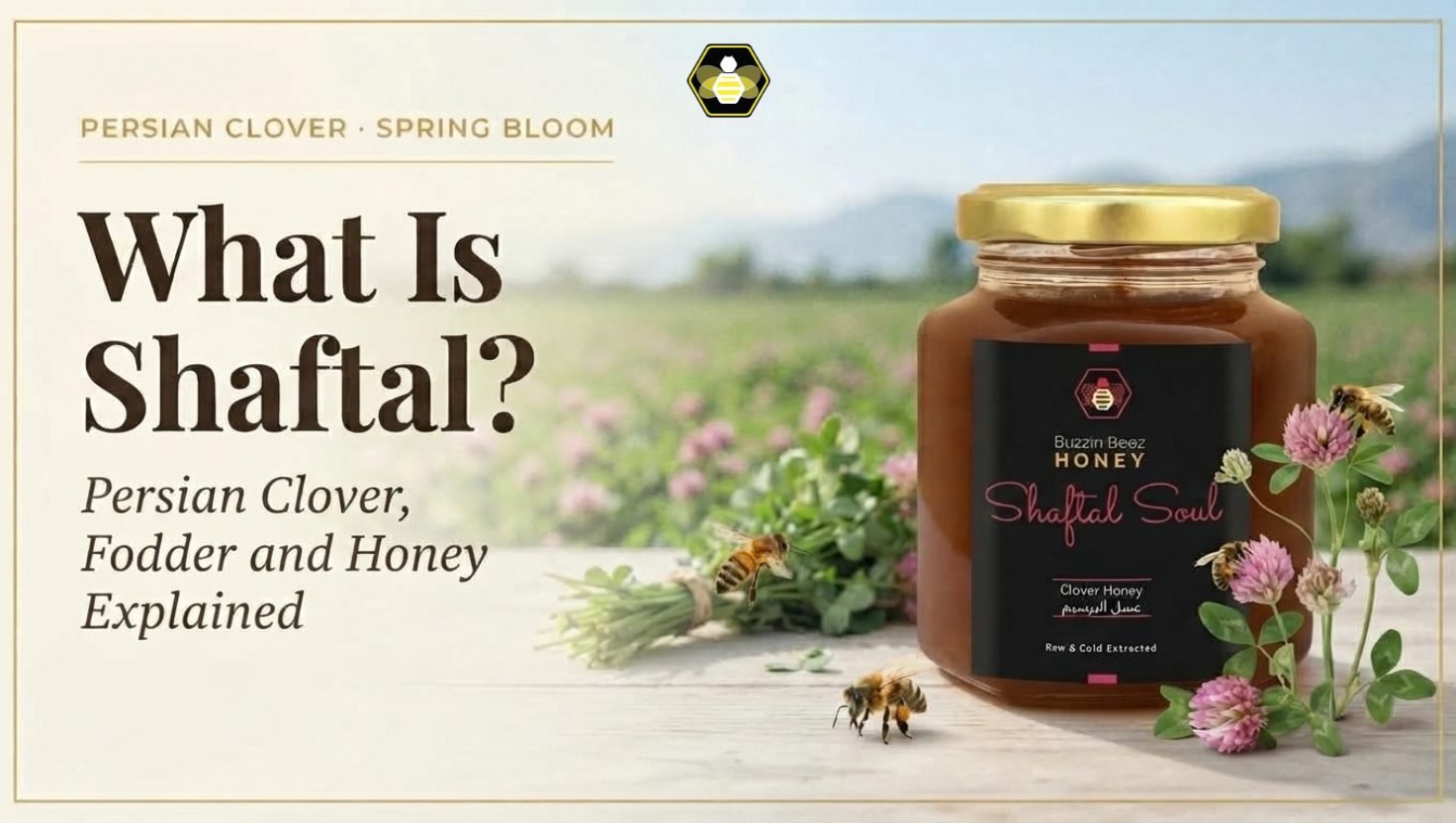
Shaftal Soul is our clover honey, raw and cold-extracted. You can also browse the Shaftal Soul range directly.
Where to Read About Clover Honey Itself
This page covers the crop. The honey has its own pages:
- Clover honey benefits and how it compares with Sidr: Clover honey vs Sidr honey
- How clover compares with acacia, orange blossom and the rest: Guide to types of honey in Pakistan
- Whether clover honey suits children: Honey for kids, is it safe?
- How to judge whether any honey is real: Spotting real honey in Pakistan
- The full range: Browse all BuzzinBeez honey
Frequently Asked Questions
What is shaftal in English?
Shaftal is Persian clover, also called reversed clover. Its botanical name is Trifolium resupinatum, and it grows across Pakistan as a winter fodder legume.
Is shaftal the same as berseem?
No. Shaftal is Trifolium resupinatum, Persian clover. Berseem is Trifolium alexandrinum, Egyptian clover. Berseem yields more forage and dominates Pakistani farming, while shaftal handles cold, frost, and waterlogging better.
Is it good for soil?
Yes. As a nitrogen-fixing legume, it adds nitrogen to the soil, and agronomists rate its soil-improvement potential above berseem. Farmers use it in rotations partly for this reason.
When does shaftal flower in Pakistan?
Farmers sow it in autumn; it grows through winter, and it flowers in spring. Fodder cutting usually happens before full bloom, which is why clover honey depends on fields left standing for seed or later cuts.
What does clover honey taste like?
Mild, light in colour and gently sweet, without the caramel weight of Sidr or the herbal finish of Ajwain. That mildness makes it a common first choice for children and new honey buyers.
Why does clover honey crystallise so fast?
Clover nectar produces honey with enough glucose to form crystals within months. Crystallisation indicates raw, unprocessed honey. Warm water restores it to liquid.
