Blog
Raw Honey Pakistan: Raw vs Pure vs Organic Honey Guide 2026

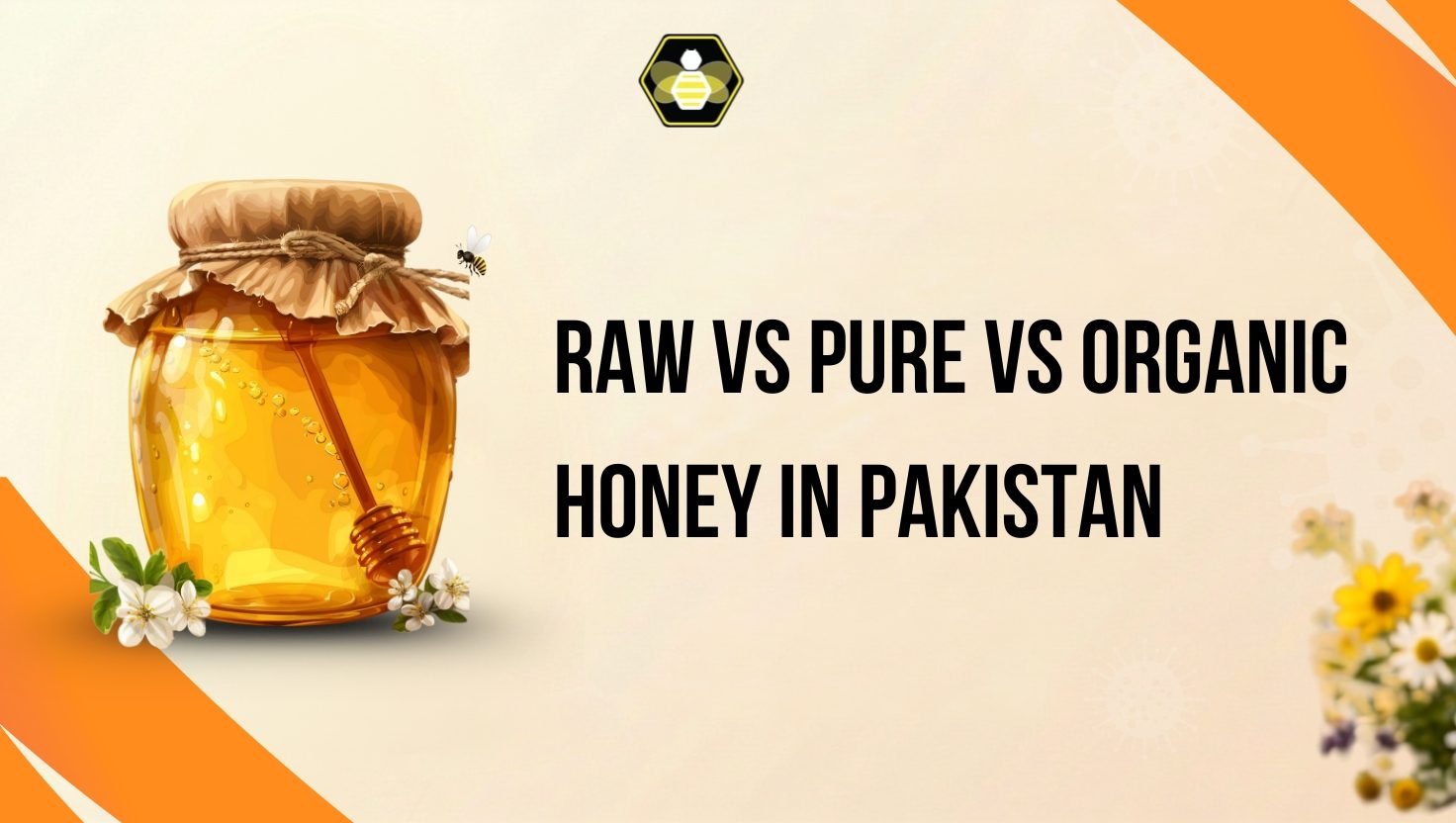
Walk into any honey shop or scroll through any online store in Pakistan, and you’ll see four words used interchangeably: raw, pure, organic, and natural. Every brand slaps at least one of them on its label. Some brands use all four at once, as if stacking adjectives somehow proves quality.
But here’s the truth most honey sellers won’t tell you: these four words mean very different things. Some carry real scientific weight. Others carry zero legal meaning and exist purely as marketing tools. If you’re searching for raw honey in Pakistan or trying to understand what “organic honey in Pakistan” actually guarantees, this guide cuts through the noise.
By the end of this post, you’ll know exactly which label to trust, which to ignore, and how to verify any claim before you spend your money.
Four Words, Four Different Things: Quick Reference Table
Before we go deeper, here’s a snapshot of what each label actually means:
| Label | What It Claims | Does It Have a Legal Standard in Pakistan? | Should You Trust It? |
| Raw | Unheated, unfiltered, unprocessed honey | No formal regulation, but scientifically verifiable | Yes, if the brand can prove it |
| Pure | 100% honey, no additives | No enforceable standard in Pakistan | Only with lab testing proof |
| Organic | Bees forage on certified pesticide-free land | No Pakistani organic honey certification exists | Rarely legitimate for Pakistani honey |
| Natural | Comes from nature, not synthetic | No legal definition anywhere in the world | Meaningless on its own |
Now let’s break each one down so you understand exactly why some labels matter and others don’t.
Raw Honey in Pakistan: Unheated, Unfiltered, and Why That Matters
When you search for raw honey in Pakistan, you’re looking for the most important quality indicator in honey. Raw honey simply means the honey has not gone through heating above the natural hive temperature (around 35 to 40 degrees Celsius) and has not gone through fine filtering that removes pollen, enzymes, and nutrients.
Why does this matter so much? Because heat destroys everything that makes honey valuable.
When commercial brands heat honey to high temperatures (a process called pasteurisation), they destroy natural enzymes like diastase, invertase and glucose oxidase. Heating also eliminates much of the natural pollen that gives each honey its unique flavour and regional identity.
The result is a clear, smooth, shelf-stable liquid that looks appealing but has lost much of what makes honey distinctive.
Raw honey, on the other hand, retains all of these properties. It may look cloudier, crystallise faster, and have a thicker texture, but those are actually signs of quality, not defects.
At BuzzinBeez, every jar undergoes cold extraction, meaning the honey moves from comb to jar without exposure to high heat at any stage. Whether you choose Bairy Nectar (Sidr), Goldy Palosa (Acacia), or Herbalicious Ajwain, every variety preserves the full spectrum of enzymes, pollen, vitamins, and minerals that make raw honey genuinely beneficial.
The bottom line: “Raw” is the single most important word to look for when buying honey in Pakistan. However, because no formal Pakistani regulation defines what “raw” means on a label, trust brands that can explain their extraction process, and ask for a lab report where a brand claims testing. Our guide to what honey lab tests check explains what to look for.
Pure Honey: The Word With the Least Legal Meaning in Pakistan
“Pure honey” is probably the most commonly used phrase on honey labels across Pakistan. Unfortunately, it’s also the most misleading.
In theory, “pure” should mean the jar contains 100% honey with no added sugar, corn syrup, rice syrup, or artificial flavouring. In practice, Pakistan has no enforceable standard that prevents any brand from printing “pure” on a jar of adulterated honey. There’s no mandatory testing, no random audits, and no penalties for false purity claims in the honey market.
This is why you’ll find jars of “pure honey” selling for Rs 500 per kg alongside jars selling for Rs 4,000 per kg. Both say “pure” on the label, but only one of them actually delivers what that word promises. If you want to understand the full picture, our guide on how to spot pure honey in Pakistan covers the details.
So how do you know if “pure” actually means pure? Look beyond the label for three things: third-party lab test reports that verify the absence of added sugars and syrups, a named floral source (Sidr, Acacia, Ajwain) rather than just generic “honey,” and transparent information about where the honey comes from and how it gets extracted.
At BuzzinBeez, we don’t lean on the word “pure” alone. We tell you the floral source and region of every honey we sell, and we cold-extract it with nothing added.
The bottom line: “Pure” on a Pakistani honey label is a claim, not a guarantee. Without lab testing to support it, the word carries no weight at all.
Organic Honey: What Certification Actually Requires, and Why Almost No Pakistani Honey Qualifies
This is the section most honey brands in Pakistan will never write, and that’s exactly why we’re writing it.
“Organic honey” is not just honey that comes from a natural environment. According to international standards set by the USDA, EU, and IFOAM (International Federation of Organic Agriculture Movements), organic honey certification requires three extremely strict conditions.
First, the bees must forage exclusively within a radius of 3 to 5 miles (5 to 8 kilometres) where every single plant, crop, and flower is free of synthetic pesticides, herbicides, and genetically modified organisms. Second, beekeepers cannot use synthetic miticides, antibiotics, or chemical treatments inside the hive. They must rely entirely on organic-approved remedies for pest control. Third, the honey must go through extraction and processing without any synthetic chemicals, artificial additives, or excessive heat.
Now consider the reality of beekeeping in Pakistan. Most beekeepers operate near agricultural regions in Punjab, Sindh, and KPK where neighbouring farms routinely spray synthetic pesticides and use chemical fertilizers. No beekeeper can control where bees fly within a 5-mile radius, and guaranteeing that every flower source within that range is pesticide-free is practically impossible in Pakistan’s agricultural landscape.
Furthermore, Pakistan currently has no functioning organic certification programme specifically for honey. While PSQCA (Pakistan Standards and Quality Control Authority) sets general food standards, no Pakistani body inspects apiaries, tests foraging zones, or certifies honey as organic according to internationally recognised criteria.
What does this mean? It means when a Pakistani honey brand labels its product “organic,” that claim carries no verification, no certification, and no accountability. The word looks good on the label, but nothing behind it meets the standards that “organic” actually requires.
We’re being transparent about this because honesty builds more trust than buzzwords. BuzzinBeez does not claim organic certification because no credible certification framework exists for Pakistani honey. Instead, we focus on what we can tell you: raw processing, cold extraction, named floral sources and traceable origins.
The bottom line: Organic honey certification requires conditions that are nearly impossible to meet in Pakistan. Any brand claiming “organic” without a recognised international certificate is using the word as marketing, not science.
Natural Honey: The Label That Means Nothing
“Natural” is the most harmless-sounding label, and also the most empty. No country in the world has a legal definition for “natural honey.” The word has no scientific standard, no regulatory framework, and no testing protocol.
Every honey technically comes from nature since bees produce it from flower nectar. So calling honey “natural” is like calling water “wet.” It describes a baseline fact without telling you anything useful about quality, purity, processing, or sourcing.
When you see “natural honey” on a label in Pakistan, it tells you nothing about whether the honey has gone through heating, whether it contains added sugars, where it comes from, or how it gets processed. The word functions purely as a feel-good marketing term designed to create a perception of quality without delivering any verifiable substance.
The bottom line: Ignore “natural” as a buying criterion entirely. It adds zero information to your purchasing decision.
Which Label Should You Actually Buy On?
After understanding what each word means (and doesn’t mean), here’s the practical framework for choosing raw honey in Pakistan:
Prioritise “raw” above everything else. Raw honey keeps its natural enzymes, pollen and character. Ask the brand specifically how they extract their honey and whether they apply any heat at any stage.
Treat “pure” as a starting point, not a finish line. Every brand claims purity. Only brands that provide lab test reports actually prove it. If a brand says “pure” but cannot show you a third-party lab report, move on.
Be sceptical of “organic” unless you see an internationally recognised certificate. In Pakistan’s current regulatory environment, “organic” on a honey label is almost always an unverified marketing claim. Do not pay a premium for a word that carries no certification behind it.
Disregard “natural” completely. It communicates nothing meaningful about the honey inside the jar.
The real question to ask any honey brand is not “Is this pure/organic/natural?” but rather “Can you show me a lab report, tell me which flowers the bees fed on, explain your extraction process, and identify where in Pakistan this honey comes from?” A brand that answers these questions clearly deserves more of your trust than one relying on adjectives. Our complete buying guide for the best honey in Pakistan covers this in more detail.
How to Verify Any Claim: 4 Tests You Can Do at Home
While lab testing remains the gold standard for verifying honey quality, here are four simple tests you can perform at home to spot obvious adulteration:
The Water Test: Drop a teaspoon of honey into a glass of room-temperature water without stirring. Genuine raw honey sinks to the bottom and holds its shape. Adulterated honey dissolves quickly because added sugars and syrups mix easily with water.
The Thumb Test: Place a small drop of honey on your thumb. Real honey stays in place and doesn’t spread or drip quickly. Adulterated honey runs off immediately because its moisture content exceeds what natural honey contains.
The Paper Test: Put a drop of honey on a piece of paper or paper towel. Pure honey sits on the surface without soaking through. If the honey absorbs into the paper quickly, it likely contains added water or syrup.
The Crystallisation Test: Leave your honey in the pantry for several weeks. Genuine raw honey crystallises over time, especially in cooler temperatures. If your honey remains perfectly liquid and clear after months, it has likely gone through heavy processing or contains added sugars that prevent crystallisation.
Important note: These home tests can catch obvious fakes, but they cannot detect sophisticated adulteration. For true verification, always look for third-party lab reports from the brand.
FAQs: Khalis, Raw Aur Organic Shahad Mein Farq Kya Hai?
Q: What is the difference between raw honey and normal honey? Raw honey has not gone through heating or fine filtering, so it keeps its natural enzymes and pollen. Normal or “regular” honey from supermarkets has typically gone through pasteurisation and heavy filtering, which removes much of this and flattens the flavour.
Q: What does “organic honey” mean in Urdu? In Urdu, organic honey translates roughly to “naamiyaati shahad” (نامیاتی شہد). It refers to honey produced by bees that forage exclusively on certified pesticide-free flowers within a specific radius of the hive, with no synthetic chemicals used in hive management. However, as explained above, this certification does not currently exist for honey produced in Pakistan.
Q: Is unprocessed honey the same as raw honey? Yes, in most contexts, unprocessed honey and raw honey mean the same thing. Both terms indicate honey that has not gone through heating, pasteurisation, or excessive filtering after extraction. When searching for unprocessed honey in Pakistan, look for brands that specifically mention cold extraction.
Q: How can I tell if my honey is genuinely raw? Raw honey tends to be thicker, cloudier, and more likely to crystallise than processed honey. It may contain tiny particles of beeswax or pollen, which are signs of minimal filtering. However, visual cues alone are not foolproof. The most reliable way to verify is through lab reports that confirm enzyme levels (particularly diastase activity) remain intact.
Q: Which BuzzinBeez honey should I buy if I want raw honey in Pakistan? Every BuzzinBeez variety is cold-extracted and reaches you raw. The choice depends on taste: Bairy Nectar (Sidr) for a rich, caramel-like honey, Herbalicious Ajwain for a mild herbal note, Pureganic Malta for bright citrus, Relaxic Lavender for a soft floral aroma, or Goldy Palosa (Acacia) and Shaftal Soul (Clover) for light, everyday sweetness.
