
Blog
Ajwain Plant to Honey Jar: Where Herbalicious Ajwain Comes From

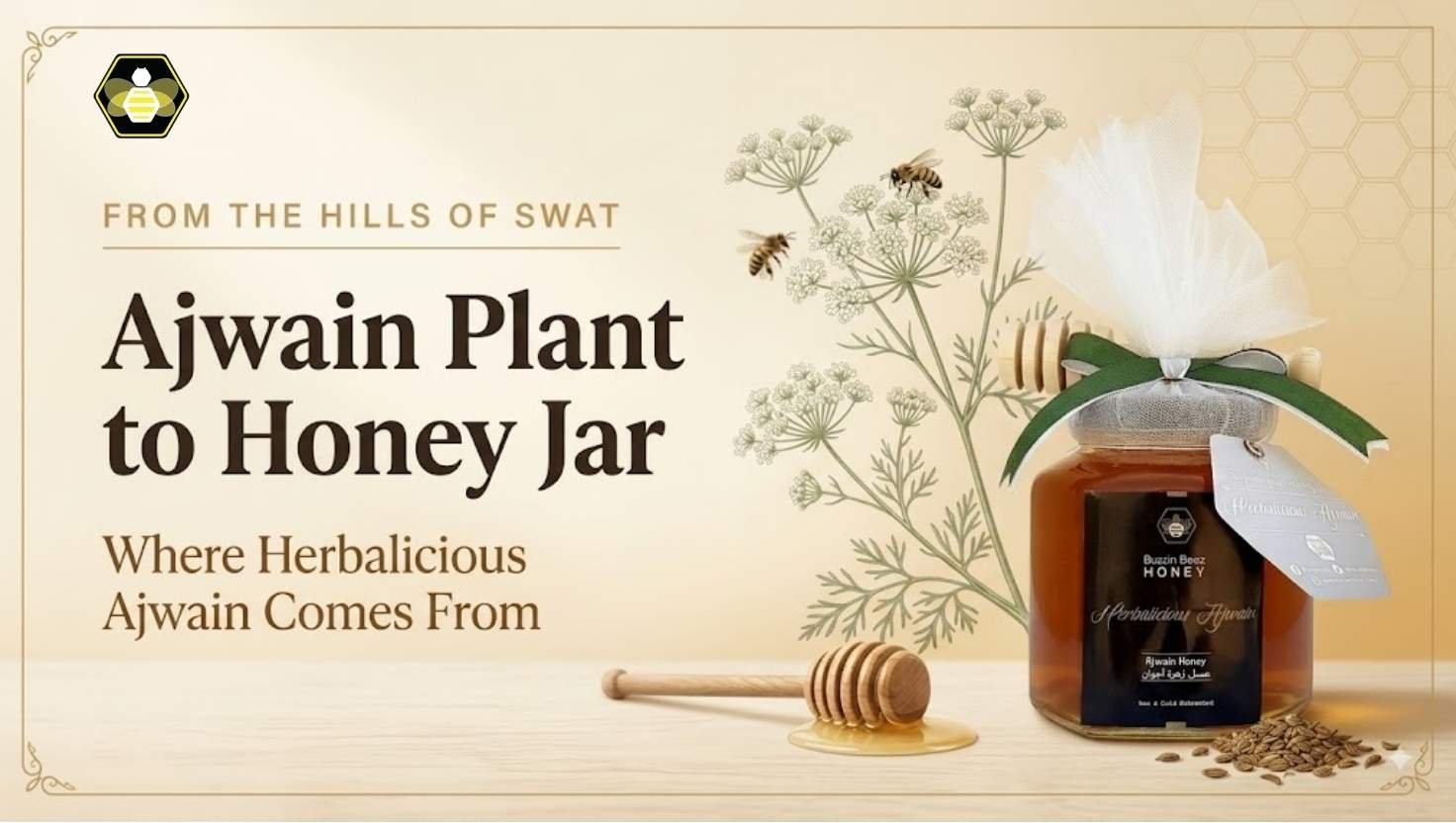
Almost every Pakistani kitchen keeps a jar of ajwain on the shelf. Far fewer people have ever seen the ajwain plant it comes from, and fewer still know that bees visit its flowers and turn that nectar into one of the most distinctive honeys produced anywhere in the country.
This guide covers the plant itself. You will find out what the ajwain plant actually looks like, which parts of Pakistan grow it, when it flowers, how that short flowering window shapes the honey, and why ajwain honey ends up light golden with a herbal aroma instead of dark and heavy.
If you came here for recipes and ways to use the honey, those are linked below, so this page can stay focused on where the honey comes from.
What Is the Ajwain Plant?
The ajwain plant is a small annual herb, not a tree. Its botanical name is Trachyspermum ammi, and it belongs to the Apiaceae family, which also gives us cumin, coriander, fennel, dill, and parsley. Anyone who has seen coriander growing will recognise the family resemblance immediately.
A mature ajwain plant reaches roughly 30 to 90 centimetres in height. It carries feathery, finely divided leaves on slender, branching stems. When it flowers, it produces clusters of tiny white blooms arranged in compound umbels, the umbrella-shaped flower heads typical of the carrot family. Each umbel holds dozens of individual flowers, and a single healthy plant can carry many umbels at once.
That flower structure matters more than it sounds. Because the blooms are small, shallow, and clustered tightly together, bees can work an enormous number of individual flowers without flying far. Consequently, a field of flowering ajwain becomes a highly efficient forage site during the weeks it stays in bloom.
One common misconception is worth clearing up here. What we call ajwain “seeds” are not seeds at all. Botanically, they are dry fruits, each one containing the actual seed inside. The distinction rarely matters in cooking, though it explains why the flavour sits in the outer casing.
That flavour comes largely from thymol, the same aromatic compound found in thyme. Thymol gives ajwain its sharp, slightly bitter, unmistakably herbal character, and traces of that same profile carry through into the honey.
Ajwain Plant Names in Urdu and Across Pakistan
Search results get confusing quickly because the ajwain plant goes by many names.
Urdu writes it as اجوائن, which transliterates to ajwain or ajwan. Some regions say ajwain ka podha when referring to the growing plant rather than the spice. English speakers usually say carom, carom seed, bishop’s weed, or occasionally ajowan caraway. Older herbal texts sometimes use the name omum.
Regional variation adds another layer. Speakers of Sindhi, Pashto, and Punjabi each have their own term, and market sellers frequently use whichever name their customers know best. Therefore, if you are searching for the ajwain plant online and getting thin results, try carom plant or Trachyspermum ammi instead.
One name to avoid confusing it with is Ajwa. Ajwa refers to a variety of dates from Madinah and has no botanical relationship to ajwain whatsoever. The two words look similar in English transliteration, yet they describe entirely different things.
Where the Ajwain Plant Grows in Pakistan
Farmers grow the ajwain plant as a rabi season crop, so it goes into the ground as the weather cools and matures before the summer heat arrives.
Growers across Punjab, Sindh, Khyber Pakhtunkhwa, and parts of Balochistan cultivate the ajwain plant, generally favouring well-drained loamy soil and open sun. The plant tolerates relatively dry conditions once established, which suits large parts of the Pakistani agricultural belt.
For honey specifically, elevation and surrounding vegetation matter as much as the crop itself. BuzzinBeez sources its Herbalicious Ajwain from the hills of Swat, where cooler nights and cleaner air produce a milder, more aromatic honey than lowland sites typically yield. Hives placed near hill-grown ajwain also face less competition from heavily sprayed commercial farmland.
Placement is the whole job for a beekeeper working with monofloral honey. Hives have to sit close enough to a concentrated stand of flowering ajwain that the bees forage predominantly on it rather than on whatever else happens to be blooming nearby. Get that wrong, and the result is a mixed wildflower honey with a faint ajwain note, not genuine ajwain honey.
From Ajwain Flower to Honey Jar
The route from the field to the jar runs through a narrow calendar window and a lot of bee traffic.
The flowering window
Ajwain sown around October and November typically flowers in February and March, with seed harvest following in March and April. Flowering itself lasts only a few weeks.
That short window is the single biggest constraint on supply. Unlike Acacia, which flowers repeatedly across wide stretches of Punjab and Sindh, ajwain offers beekeepers one brief opportunity each year. Missing it by ten days means waiting until the following season. As a result, genuine mono-floral ajwain honey stays scarcer than the everyday varieties, and its price reflects that.
What the bees actually do
Foraging bees collect nectar from the ajwain umbels and carry it back in a specialised honey stomach. Inside the hive, worker bees pass the nectar between themselves repeatedly, and during this process, enzymes, including invertase, begin breaking the complex sugars into simpler ones.
The bees then deposit the nectar into wax cells and fan it with their wings to evaporate excess moisture. Fresh nectar can be seventy per cent or more water; finished honey sits closer to seventeen or eighteen per cent. Once the moisture drops far enough, the bees cap each cell with a thin layer of wax. Capping is the signal that the honey is ripe and ready.
Pollen and trace plant compounds from the ajwain flowers travel through this entire process and remain in the finished honey. Those traces are what make a mono-floral honey identifiable in the first place.
Extraction without heat
After the frames come out of the hive, the extraction method determines how much of that work survives.
BuzzinBeez uses cold extraction, meaning the honey never rises above the natural hive temperature at any stage. Enzymes stay active, pollen stays present, and the volatile aromatic compounds that carry the ajwain character remain intact. By contrast, heat processing produces a clearer, more uniform product while destroying much of what distinguishes one variety from another.
Why Ajwain Honey Looks and Tastes Different
Ajwain honey is light golden rather than dark amber, and people occasionally read that lightness as a sign of dilution. In reality, colour in honey tracks the mineral and pigment content of the nectar source, not purity.
Sidr nectar from wild Beri trees produces a dark, dense honey. Ajwain nectar simply does not carry the same pigment load, so the finished honey stays pale. Our guide to beri ka shehad covers that contrast in more depth, and the Palosa tree guide explains why Acacia honey runs lighter still.
Aroma is where ajwain honey separates itself completely. Trace thymol and related compounds carried over from the flowers give it a warm herbal note underneath the sweetness, closer to thyme than to anything floral. Most people notice it on the finish rather than the first taste.
Texture sits between the extremes. Ajwain honey is thicker than Acacia yet looser than Sidr, and it crystallises at a moderate pace. Crystallisation, incidentally, indicates authenticity rather than spoilage, since glucose in raw honey naturally forms crystals over time.
Ajwain Honey, Ajwain Seeds, and Ajwain Water Are Not the Same Thing
These three are treated as interchangeable in conversation, and they are not.
Ajwain seeds are the dried seeds of the plant, used whole in cooking. They deliver concentrated thymol and the strongest, sharpest flavour of the three.
Ajwain water comes from steeping or boiling those seeds. Households across Pakistan prepare it at home, and the strength varies entirely with how much seed goes in and how long it steeps.
Ajwain honey is something different in kind. Bees produce it from the nectar of ajwain flowers, so it contains honey sugars, enzymes, and pollen alongside the trace aromatic compounds. Crucially, it differs from honey with ajwain stirred in, and no seeds enter the process at any point.
That last distinction catches people out regularly. Some sellers market “ajwain-infused honey,” which means ordinary honey blended with ajwain extract or ground seed after the fact. Genuine mono-floral ajwain honey, by contrast, comes from the flowers themselves and requires hives placed in a flowering field during a short seasonal window. Check the label wording carefully, because infused and mono-floral products sit at very different price points for good reason.
How to Recognise Genuine Ajwain Honey
A few sensory checks help before you commit to a jar.
Look at the colour. Honey from the ajwain plant should be light golden. Anything markedly dark is unlikely to be ajwain.
Smell it before tasting. A genuine jar carries a distinct herbal note. Flat, generic sweetness with no aroma suggests blending.
Taste the finish. The thymol character shows up after the sweetness fades, not during it.
Check the wording on the label. “Ajwain honey” and “ajwain-infused honey” describe different products.
Ask for documentation. Sensory checks catch obvious substitutions, though only laboratory analysis confirms purity properly. Any brand claiming mono-floral status should produce a report on request.
For a fuller walkthrough covering all varieties, see our guide to the different types of honey in Pakistan.
Where to Read More
We have deliberately kept this page focused on the plant and the production process. If you want the health side, these cover it properly:
- Ways to use it in warm water and tea: Using ajwain honey every day
- Summer drinks: Ajwain honey in summer
- Winter drinks and taste notes: Ajwain honey in Karachi winters
You can also browse the full honey range to compare ajwain against the other varieties.
Frequently Asked Questions
Is ajwain a tree or a plant?
Ajwain is an annual herb, not a tree. It grows to roughly 30 to 90 centimetres and belongs to the same botanical family as cumin, coriander, and fennel. Descriptions calling it a tree are inaccurate, though the confusion is common because most other mono-floral honeys in Pakistan do come from trees.
What is the ajwain plant called in English?
Most commonly, carom or carom seed. You may also encounter bishop’s weed, ajowan caraway, or the botanical name Trachyspermum ammi.
Where does ajwain honey come from in Pakistan?
Ajwain grows across Punjab, Sindh, Khyber Pakhtunkhwa, and parts of Balochistan. BuzzinBeez sources its Herbalicious Ajwain from the hills of Swat, where cooler conditions produce a milder, more aromatic honey.
When is ajwain honey harvested?
Ajwain is generally sown in October and November and flowers in February and March. Beekeepers place hives during that short flowering window, which is why mono-floral ajwain honey remains less abundant than year-round varieties.
Is ajwain honey the same as ajwain water?
No. Ajwain water comes from steeping ajwain seeds at home. Bees produce ajwain honey from the nectar of ajwain flowers, and it contains no seeds whatsoever.
Why is ajwain honey light in colour?
Honey colour reflects the pigment and mineral content of the nectar source. Ajwain nectar carries less pigment than Sidr nectar, so the finished honey stays pale. Lightness says nothing about purity.
