
Blog
What Is Malta Honey? Pakistan’s Orange Blossom Explained

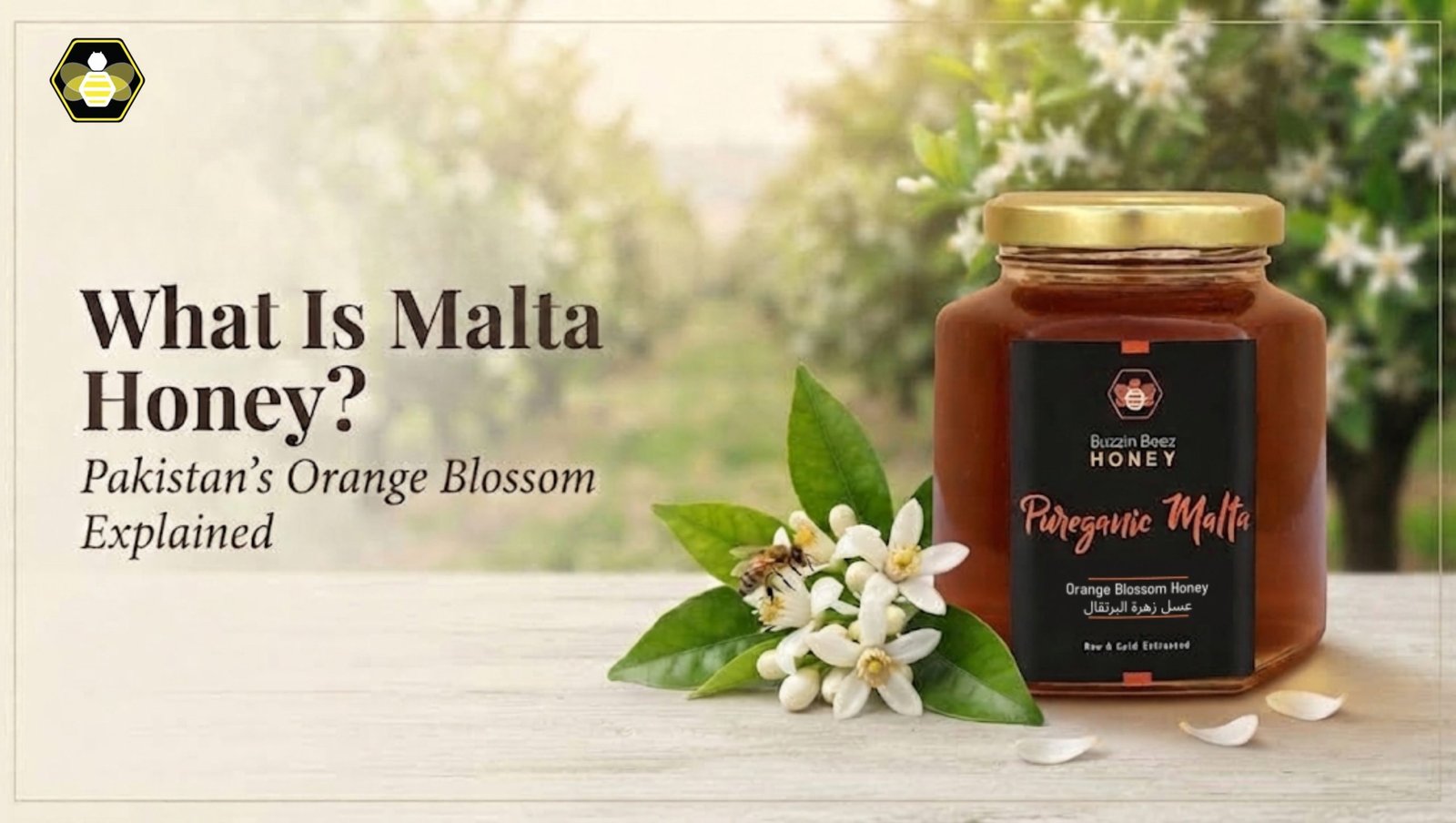
Every Pakistani winter brings crates of malta to the fruit stalls, and almost everyone recognises the fruit. Far fewer people connect it to the jar of pale golden honey sold as malta honey, and fewer still realise that the honey and the fruit come from opposite ends of the calendar.
This guide explains where malta honey actually comes from: which citrus variety produces it, where those orchards sit in Pakistan, when the trees flower rather than when they fruit, and why the name confuses buyers outside the country.
Recipes and everyday uses have their own pages, linked near the end, so this one stays on the orchard.
Malta, Kinnow or Mosambi: Which Orange Makes Malta Honey?
Pakistani citrus covers several distinct fruits that outsiders lump together, so it helps to separate them.
Malta (مالٹا) is the sweet orange, Citrus sinensis. It reaches markets from December through March with a January peak, grown mainly around Sargodha, Layyah, and parts of Khyber Pakhtunkhwa. The deep-fleshed blood-red malta is the prized local variety.
Kinnow (کینو) is a mandarin hybrid rather than a sweet orange, and it dominates Pakistani citrus commercially. Sargodha and Bhalwal form its heartland.
Mosambi (موسمی) is the sweet lime, milder again, running from November into February.
All three belong to the genus Citrus, and all three flower. Bees do not read variety labels, so any honey from a mixed Pakistani orchard carries nectar from whichever citrus happens to be blooming nearby. Pureganic Malta takes its name from malta because that is the orange Pakistani households know, though the broader international term for this style is orange blossom honey.
Worth noting for anyone comparing jars: malta honey and orange blossom honey describe the same thing. One name is local, the other is what the export market recognises.
Where Pakistan’s Orange Blossom Honey Comes From
The geography behind malta honey is unusually simple, because Pakistan’s citrus sits overwhelmingly in one place.
Punjab accounts for more than 95 per cent of national citrus production. Provincial agriculture figures put the planted area at roughly 177,000 hectares, producing over two million tonnes. Nationally, Pakistan ranks around sixth among the world’s orange producers, working some 160,000 hectares for 2.1 to 2.3 million tonnes a year.
Sargodha sits at the centre of it. Locals call the district the California of Pakistan, and the Pakistan Journal of Agricultural Research credits it with roughly 96 per cent of national kinnow output. The Punjab government established a dedicated Citrus Research Institute there in 2003 and 2004. During harvest, citrus work directly employs more than half a million people in Sargodha district alone.
Two things follow for malta honey. First, concentration helps: dense contiguous orchards give bees a genuinely mono-floral nectar source rather than a scattered one. Second, and less comfortably, commercial citrus is a sprayed crop, so hive placement within the belt matters enormously for what ends up in the jar.
BuzzinBeez lists Pureganic Malta as single-origin honey.
The Season Nobody Expects: Blossom Comes After Fruit
Here is the part that catches almost everyone out.
Ask a Pakistani when malta season runs, and the answer comes instantly: winter, December to March. That answer describes the fruit. Malta honey, however, has nothing to do with fruit.
Honey comes from nectar, and nectar comes from flowers. Citrus trees in the Punjab belt finish fruiting in early March and flower in spring afterwards, generally through March and April as temperatures climb. The blossom window therefore opens roughly when the fruit season closes.
That gap creates a practical consequence. A beekeeper wanting mono-floral orange blossom honey has to position hives in spring, weeks after pickers strip the orchards and long after anyone is thinking about malta. Miss those few weeks and the opportunity waits a full year.
Bloom length compounds the problem for anyone producing malta honey. Citrus flowers for a matter of weeks, not months, and unseasonal rain during that window keeps bees inside while washing nectar from the blossoms. Supply consequently varies year to year in ways that fruit yield alone would not predict.
Compare this with Sidr, which flowers once or twice annually in remote terrain, a constraint our guide to beri ka shehad covers in detail. Citrus is far more accessible, yet the timing discipline is just as unforgiving.
Why “Malta Honey” Confuses Buyers Outside Pakistan
Search for malta honey internationally and results split in two directions, because the word carries entirely different meanings depending on where you stand.
In Pakistan, malta means a sweet orange. In most of the world, Malta means a Mediterranean island nation, and Maltese honey is a genuine product category from there, typically thyme or wildflower rather than citrus.
Consequently, a Pakistani jar labelled malta honey reads as orange blossom honey to a local shopper and as Mediterranean honey to an international one. Neither reading is wrong, and both are entirely understandable.
Global orange blossom honey adds another layer. Spain, Morocco, Florida, and California dominate that category, and their product sets the reference points most buyers carry. Pakistani orange blossom honey rarely appears in those conversations despite the country’s citrus scale.
For anyone buying locally, the practical takeaway is simple: read the Urdu. مالٹے کا شہد settles the question immediately.
Naming confusion of this kind runs throughout the honey market. Our guide to acacia honey in Urdu covers an even stranger case, where the honey sold globally as acacia comes from a tree that is not an acacia at all.
What Citrus Nectar Does to the Honey
Nectar source shapes every sensory quality of malta honey, and citrus leaves unmistakable marks.
Colour stays pale, running light golden to straw rather than the dark amber of Sidr. Citrus nectar simply carries less pigment.
Aroma is where orange blossom announces itself. The floral compounds in citrus blossom carry through the whole process, producing a bright, fresh perfume noticeable before the jar reaches your mouth.
Flavour follows with fruity sweetness and a light tang. That slight acidity distinguishes it from the flat sweetness of blended supermarket honey.
Crystallisation happens at a moderate pace, faster than Acacia and slower than Clover. Many buyers read crystallisation as spoilage when it actually signals the opposite. Raw honey crystallises because glucose naturally forms solid structures over time, and standing the jar in warm water for a few minutes reverses it. Our guide to raw, pure and organic honey explains which label terms carry real meaning in Pakistan and which do not.
How to Recognise Genuine Orange Blossom Honey
A few checks help before you commit.
Smell before tasting. Genuine citrus blossom honey carries an obvious floral brightness. Absence of aroma suggests heat processing or a different nectar source.
Expect pale, not dark. Very dark honey sold as malta honey deserves questions.
Taste for the tang. Real malta honey carries a light acidic finish underneath the sweetness. Flat, uniform sweetness points to blending.
Read the label wording. Orange blossom honey and orange-flavoured honey are different products entirely.
Ask for documentation. Sensory checks catch obvious substitution, while laboratory analysis confirms purity properly. Our guide to spotting real honey in Pakistan walks through each test in more depth.
Where to Read More
This page covers the origin and identification of malta honey. Other pages handle the rest:
- Taste and uses: Pureganic Malta honey guide
- How orange blossom compares with clover, acacia and Sidr: Guide to types of honey in Pakistan
- Warm winter drinks with citrus honey: Winter honey drinks
- Current sizes and pricing: Pureganic Malta product page
- The full range: Browse all BuzzinBeez honey
Frequently Asked Questions
What is malta honey? Malta honey is orange blossom honey produced when bees forage on the flowers of malta (sweet orange) trees. Malta is the Urdu name for the sweet orange, so مالٹے کا شہد and orange blossom honey describe the same product.
Is malta honey the same as orange blossom honey?
Yes. Malta is the local Pakistani name, and orange blossom is the international term. Both describe honey from citrus blossom nectar.
Where does orange blossom honey come from in Pakistan?
From the Punjab citrus belt, which accounts for more than 95 per cent of national citrus production. Sargodha sits at its centre, with Layyah, Bhalwal and parts of Khyber Pakhtunkhwa also growing significant citrus.
When is malta honey harvested?
The blossom, not the fruit, determines the timing. Citrus trees in Punjab flower in spring, generally through March and April, after the winter fruit harvest ends in early March. Beekeepers work that short window, so the honey season follows the fruit season rather than coinciding with it.
Why is my malta honey crystallising?
Because it is raw. Glucose in unprocessed honey forms crystals over time, particularly in cooler weather. Stand the jar in warm water for a few minutes, and it returns to liquid. Honey that never crystallises has usually been heat-treated.
Is Pakistani orange blossom honey different from Spanish or Moroccan?
The nectar source is comparable, since all come from citrus blossom. Local honey reaches a Pakistani buyer far fresher and cheaper, because imported honey spends weeks or months in transit and carries duty and freight costs.
